#19 Can you think of anything that:
1) should not be photographed? Why?
I think everything should be able to be photographed.
2) cannot be photographed? Why?
Exact replications of the past. I’m also starting to believe it is impossible to create a photo that is not influenced by the photographer; which makes art more of an art form to me than it used to be.
3) you do not want to photograph? Why?
Two dimensional objects because there in no depth and no point.
#20 Describe at least one photograph that you could take for each of the following "place" prompts.
• An image of a synthetic “place” such as Disney World, Las Vegas, a Hollywood set, a diorama, etc.
It would be humorous to take pictures of crying children in such a happy place as Disney World. But I would love to take pictures of the super excited kids. Capture their excitement and happiness. I’d also like to take pictures of the happy parents because you’d be surprised that some parents get just as excited and giddy as the children do when they arrive at Disney World.
• An image of a fantasy/fictitious environment concocted from your imagination.
I’ve been listening to a lot of music and thinking of ways to compose a photograph to represent the song. I think I would do that if the prompt was to create a fictitious environment.
• An image of a placeless space such as the Internet, cell phones, e-mail, e-bank, surveillance, etc.
Hmmmm I’d probably construct a photo of the old ways of communication. Have a man riding a horse with a bag of mail in a large bag. Show people writing letters, people researching through books, communicating face to face. Visually show what is going on with no technology. It would be interesting to have a prompt be online chatting. Have two people communicating via the internet and photograph their posture, what they are wearing and their face expressions. Then take the photographs and edit out the computer and have the two photos of the people so they are face to face. You’d probably never guess that they were having a communication.
• An image of a public space.
Many options for that. I would show human activity or make sure there are clues that a human has been in that place. Whether it be litter, Writing, art work, footprints in the sand, tire marks…
• An image of a private space.
I would photograph something the viewer can not relate to or a place that is unfamiliar to the viewer.
• An in-between space that brings to mind one of the following ideas: nomadic lifestyles, displacement, rootlessness, out-of-placeness, boundaries, movement, expansion, etc.
I would try to document unfamiliar cultures.
#21
A. Describe some common aesthetic aspects of “news”-related photographs.
The excitement of something new, being in the know, capturing a real moment and feeling a sense of connect or disconnect, drama, capturing what you shouldn’t see
B. Describe some common aesthetic aspects of “snapshots”, including family photographs, cell-phone shots, photos posted to facebook,
Familiarity, closeness, memories, looking your best, documentation
C. Describe some common aesthetic aspects of advertisement photographs, including fashion photography, product photography, etc
Fake, making whatever you are photographing look as appealing as possible, or unappealing…depending on what the objective of the photograph is. Set up, planned out, creative.
D. Describe some common aesthetic aspects of film/movie and television stills.
Different perspective, frozen moment, behind the scenes, making entertainment into art, putting a new spin on the photo, second guessing
E. Describe some common aesthetic aspects of yearbook photos, senior pictures, and team/club/sports group shots.
Repetitiveness, visualizing growth, memories, pride, constructed lighting
F. Describe some common aesthetic aspects of stock images. http://www.corbisimages.com/ http://www.gettyimages.com/
I don’t see a theme to these images I’m confused…but they are aesthetically pleasing
G. Describe some common aesthetic aspects of fashion photography.
Beauty, avant-garde, color, creativity, acting, construction, showing off
H. Describe some common aesthetic aspects of paparazzi shots or celebrity photographs.
Gossip, in the know, beautiful people, interesting lives, personal, trying to make them seem like everyday people, or fantasizing their lifestyle and making the viewer wish they had it
Sunday, June 12, 2011

Wednesday, June 8, 2011


Tuesday, June 7, 2011
Blog Prompt Week 3 #11-18
11. A place from my past would be a cottage we went to in Northport, Michigan. It was the first I remember of our trips up north. It was a cute modern cottage with what seemed like hundreds of steps to get to and from lake MI. When you finally reached the beach it wasn't a beach. It was rocks upon rocks but wow the view was beautiful and the water was fun. We had a blast. There were a lot of swarming black flies too but when you are young those things don't matter.
12. There is a photograph of my brother and I holding hands, walking to the ocean. My mom took it from behind us. My grandpa is to the left of my brother reaching for his hand and my brother is looking up at him. It is precious.
13. I would make a fort, or some kind of shelter. It would be life size. I like using my imagination as i did as a kid to make found natural objects into manmade objects in my fort. I'd use a lot of stones and sticks and a pile of pine needles as my bed.
14. I like the idea of places untouched by humans, but also when humans naturally leave their mark. like a footprint or carving in the tree, ambers left from a fire, or water dripping from an umbrella.
15. Bringing past and present together I'd probably do my childhood bedroom and the bedroom I have at my apartment. They are both very intimate and comfortable spaces for me, they mean the same to me, they just hold different memories and different parts of my life.
16. “Photography can only represent the present. Once photographed, the subject becomes part of the past. Berenice Abbott
I don't think that is necessarily true, it kind of confuses me actually because I usually when you think of a photograph you think of the past.
17. “Landscape photography is the supreme test of the photographer—and often the supreme disappointment.” Ansel Adams
It is difficult to make a successful landscape photograph, so when you make one that becomes well known and received, it is rewarding. The disappointment may be that many people fail when they attempt to photograph landscapes.
18.“I think photographs should be provocative and not tell you what you already know. It takes no great powers or magic to reproduce somebody's face in a photograph. The magic is in seeing people in new ways.” Duane Michals
I agree with this quote it is very true. That is what makes photography art, opening people's eyes to a new perspective, or a new creation. They should tell the viewer something from their perspective, it may be something known, but it is in a fresh light.
12. There is a photograph of my brother and I holding hands, walking to the ocean. My mom took it from behind us. My grandpa is to the left of my brother reaching for his hand and my brother is looking up at him. It is precious.
13. I would make a fort, or some kind of shelter. It would be life size. I like using my imagination as i did as a kid to make found natural objects into manmade objects in my fort. I'd use a lot of stones and sticks and a pile of pine needles as my bed.
14. I like the idea of places untouched by humans, but also when humans naturally leave their mark. like a footprint or carving in the tree, ambers left from a fire, or water dripping from an umbrella.
15. Bringing past and present together I'd probably do my childhood bedroom and the bedroom I have at my apartment. They are both very intimate and comfortable spaces for me, they mean the same to me, they just hold different memories and different parts of my life.
16. “Photography can only represent the present. Once photographed, the subject becomes part of the past. Berenice Abbott
I don't think that is necessarily true, it kind of confuses me actually because I usually when you think of a photograph you think of the past.
17. “Landscape photography is the supreme test of the photographer—and often the supreme disappointment.” Ansel Adams
It is difficult to make a successful landscape photograph, so when you make one that becomes well known and received, it is rewarding. The disappointment may be that many people fail when they attempt to photograph landscapes.
18.“I think photographs should be provocative and not tell you what you already know. It takes no great powers or magic to reproduce somebody's face in a photograph. The magic is in seeing people in new ways.” Duane Michals
I agree with this quote it is very true. That is what makes photography art, opening people's eyes to a new perspective, or a new creation. They should tell the viewer something from their perspective, it may be something known, but it is in a fresh light.
Recreation 03

The memory I am recreating is running the 800 in high school track. It is from my perspective, as if I was running the race. I chose this part of the track because this is the best part of the race, when I have the most adrenaline, turning around the corner to finish the last 100. I made the shutter speed pretty long and jogged around the corner, so you can feel the movement. Capturing the movement is the most important part of the composition as well as the placement on the track. The half mile was the event I ran through middle school and high school. Some of my strongest emotions and most proud accomplishments came from running, so I went back to my hometown of Ionia to capture the memories of running the race.
Contemporary Photographer: Place
Anna Beeke


Series: Untangling Threads


Anna Beeke is based out of Brooklyn, New York. She received education through the international center of photography's 2009 photojournalism and documentary photography program.
Untangling threads is a series of female artisans in Morocco's rug weaving industry. The project seeks to document the environment and culture of female weavers. Carpets are sold for large dollar amounts, but they receive little of the profit. This allows the cycle of poverty and child labor in Morocco to continue. The photographs aim to highlight the faces behind production who bring the carpets to the world.
Beeke's photos are very inspiring to me, they are beautiful compositions that evoke emotion. The photos are a social documentation, they seem to be unconstructed views of reality. The photos of places and cultures are not highlighted in the news, her photos allow you into other worlds through photography.
Historical Photographer: Place
 |
| Gustave Le Gray, Brig Upon Water |
Le Gray was born in 1820. He has been called the most important French photographer of the nineteenth century because of his many technical innovations, which included improving paper negatives by waxing them before exposure, and combination printing. An example of combination printing is in the photo above. He created a seascape by using one negative for the water and one negative for the sky. He did this at a time where it was impossible to have the sky and the water in a photograph at the same time because the luminosity range was too extreme. This was an important step in photography that opened doors for more to be documented.
His success started with portraiture, but his most famous work were the photographs of seascapes. He did a lot of traveling and eventually established himself in Cairo in 1864, where he remained for about twenty years until death.
This seascape is such a beautiful scene. I've realized that I take for granted how easy it is to take a photo now compared to the tedious processes and limited exposure options from the past. The sail boat in this photo is perfectly framed in the middle of the sea. I love the lighting, it is a very relaxing photo.
Wednesday, June 1, 2011
Assignment 2: Portrait


 |
| Untitled I |
 |
| Untitled II |
 |
| Untitled III |
Written Statement Part I
Untitled I:
The composition for this photo is not constructed. We were laying in the sun when I decided to take photos of my friends from various perspectives. This image turned out most successful.
My concept was intimacy because they are two close friends. I wanted to capture a sense of comfort between the photographer and the subjects. That may not be very successful in this photo. It seems that they are unaware that the photo is being taken. Their jewelry and bathing suits capture their expression through attire. I learned about the angles photographs can be shot from, got more comfortable with aperture settings, and allowing the focus of a portrait not to be a face.
There was no constructed method in taking this photo. I was lucky that it was a bright day and that I had friends that allowed me to photograph them for the weekend. I guess I observed my environment and decided the two of them lying next to each other would make a good portrait. My motivations for this image were to capture a moment of relaxation. We were doing something we loved to do-be together and be in the sun, so my intent was to convey solace.
The context of my work speaks specifically to the culture of young adult women in America. Almost all of the women my age like to tan in the sun and be with friends, which is shown in the photograph. Their choice of bathing suit style, jewelry, and sunglasses trend with current styles, so it puts the viewer in present day.
Untitled II:
Perspective, framing, and lighting are what make this composition. The perspective is from above the bed and the frame includes the whole bed, their bodies, and part of the night stand. It is a little off center and out of focus, which is slightly acceptable for this photo because the content and patterns are interesting enough. The light is coming from a side window.
The concept goes along with the comfort and relaxation mood of the last photo. For this image it is their positions and their feet dangling off the bed that give a lot of expression. The quilt has a lot of expression, which, alongside their feet, make the photo have a silly characteristic.
This photo's method of construction was observing my environment. I woke up much earlier than they did, so while they were sleeping I took numerous photos until it eventually woke them up. I had to set a long shutter speed because it was pretty dark in the room.
My motivation for this image is the same as the last photo; which is to capture the girls in a relaxed, comfortable atmosphere. It was goofy taking the photographs, so I'm satisfied that the photo gives a humorous nature.
Unfortunately I can't think of any deeper context for the photo. It has a shallow surface when it comes to more complex meaning. I'd compare this photo to that of a photographer who does humorous and expressive and non constructed work.
Untitled III:
For the composition I framed my profile, zoomed in on my chin so that it would be the focus. It is emphasized with the lighting.
The concept is for personal growth. I focused on an insecurity-my chin-and showed it at an angle I rarely see, my profile. I don't think many people like seeing portraits of themselves from the side because they are not used to seeing themselves that way. This photo shoot was a way of getting used to a part of me I am uncomfortable with.
The method I used was using the self timer, having the camera on the tripod and taking tons of photos. I stood next to a window during the day so I could get good lighting. I repositioned the camera and myself to try different lighting angles until the right one fit.
My motivations were the same as my concept, which was to photograph and insecurity about myself until I began to accept it as part of me.
The context is psychological as a sort of therapy to lead to self acceptance.
Part II
Untitled I: Others interpreted the image as very familiar, relatable, and subtly portraying popular culture with the way the girls are dressed and their activity. The composition is working, I wouldn't change anything about this photo. It is my favorite of all the photos . The photo can be a jumping off point for popular young adult leisure, which is very relatable and recognizable and fun. I loved taking pictures at the cottage.
Untitled II: This image was interpreted as very playful, fun, and again familiar. The composition is pretty strong, classmates liked the kind of off center camera angle, but I am bummed the focus is slightly fuzzy. The improvement I would make would be to have brightened up the room a little more and made sure the focus was crisp. A jumping point could be taking pictures of other people in their sleep and in their own bed, with or without a significant other or a friend. Body posture says so much about a person as well as the intimacy of a bed.
Untitled III: I guess i don't know how others interpreted this image because i explained it before people commented. And it is a personal concept so I don't know if many assumed it was about insecurities about my chin. I guess to clarify that that is what it is about I could have made the background completely black or white. The lighting is most successful in the photo. A jumping point could be letting people take pictures of their own insecure places on their body.
Blog Prompts Week 2 #5-10
#5 Give your thoughts on one or both of the following quotes.
“Photography records the gamut of feelings written on the human face, the beauty of the earth and skies that man has inherited, and the wealth and confusion man has created. It is a major force in explaining man to man.” ~Edward Steichen
Steichen is stating that photography reveals the truth that is happening in the world. It records the beauty, such as relationships, love, and nature, as well as the ugly. Steichen believes man has created a mess of the world with the technology and greediness . He thinks the wealth and confusion mask the beauty of the world. By stating this last, he gives me that impression. There is truth to "the wealth and confusion man has created." But it is important to also make documentation of the wonderful progress humans have made and the good created and shared.
#6 In your opinion, when is it beneficial, ethical, or appropriate to digitally alter photographic portraits? When do you think it is inappropriate or ethically wrong?
When the work is for the photographer's personal and will not effect anyone's story or character in a harmful or false way, it is ok then to digitally alter photographs. It can be beneficial to enhance the story being told or make a point more clear.
It is inappropriate for the photographer to alter a photograph when he or she is trying to make a statement based on something false. It is also wrong if he or she is misrepresenting a culture, event, or person. Especially if they do not have the person's consent.
#7 Pay close attention to the types and number of photographic portraits you see in one day. Where did you see them? How do you think that the content of the portrait changes based on the context in which you see the image (news, facebook, magazine, advertisement, television, youtube, etc)? In other words, what is the difference between the portraits you see on facebook vs. those on the news? What is the difference between the “viewpoint” of the photographer in each situation? What is the difference between their “intents”?
“Photography records the gamut of feelings written on the human face, the beauty of the earth and skies that man has inherited, and the wealth and confusion man has created. It is a major force in explaining man to man.” ~Edward Steichen
Steichen is stating that photography reveals the truth that is happening in the world. It records the beauty, such as relationships, love, and nature, as well as the ugly. Steichen believes man has created a mess of the world with the technology and greediness . He thinks the wealth and confusion mask the beauty of the world. By stating this last, he gives me that impression. There is truth to "the wealth and confusion man has created." But it is important to also make documentation of the wonderful progress humans have made and the good created and shared.
#6 In your opinion, when is it beneficial, ethical, or appropriate to digitally alter photographic portraits? When do you think it is inappropriate or ethically wrong?
When the work is for the photographer's personal and will not effect anyone's story or character in a harmful or false way, it is ok then to digitally alter photographs. It can be beneficial to enhance the story being told or make a point more clear.
It is inappropriate for the photographer to alter a photograph when he or she is trying to make a statement based on something false. It is also wrong if he or she is misrepresenting a culture, event, or person. Especially if they do not have the person's consent.
#7 Pay close attention to the types and number of photographic portraits you see in one day. Where did you see them? How do you think that the content of the portrait changes based on the context in which you see the image (news, facebook, magazine, advertisement, television, youtube, etc)? In other words, what is the difference between the portraits you see on facebook vs. those on the news? What is the difference between the “viewpoint” of the photographer in each situation? What is the difference between their “intents”?
I see most portraits through advertisement and magazines. There are a lot of portraits on the internet that I don’t pay attention to, and of course when I get on facebook, I see an overwhelming amount. Most that I see are not candid, they are posed to represent something. I suppose you never know for sure the authenticity of any of it. On the news, you assume there is validity in the events that are captured through photography. You cannot trust that what you see on facebook is the truth. The biggest difference is trusting that you are seeing what is real. But both alter what they choose to show to better their story, or in facebook’s case, how much fun the person’s life looks virtually.
#8 “My portraits are more about me than they are about the people I photograph.” ~Richard Avedon.
This man has a style, or way of taking photographs that is more important in his work than the subject itself. The portraits he takes must be influenced by his personal taste and rendering. It would be interesting to give ten photographers the same camera, subject, and room, and see how their photos differ and how they represent the subject differently.
#9 “You don't take a photograph, you make it.” ~Ansel Adams
The photographer is in control of what is being portrayed. He or she can alter the framing, the lighting, the subject, to enhance the direction he or she wants the photograph to take.
#10 “All photographs are there to remind us of what we forget. In this - as in other ways - they are the opposite of paintings. Paintings record what the painter remembers. Because each one of us forgets different things, a photo more than a painting may change its meaning according to who is looking at it.” ~John Berger
#10 “All photographs are there to remind us of what we forget. In this - as in other ways - they are the opposite of paintings. Paintings record what the painter remembers. Because each one of us forgets different things, a photo more than a painting may change its meaning according to who is looking at it.” ~John Berger
Ahh this confuses me a bit. There is validity in this for some people. I don’t think I have enough experience in either field to take a position. The process in creating both is completely different. I guess I see that Berger is saying you can leave a lot of information out in a painting that cannot as easily be deleted in a photo. But both can greatly alter reality. I have started to believe that it is rare that a photograph captures reality. Especially when it comes to portraits because who knows what is real in reality. People are so complex; it is bold to say you’ve captured who a person is within one photograph. But if it does happen, how do you know when it is real? It has become a guessing game for me and I have altered the focus of my thoughts when viewing photographs.
Contemporary Photographer Portrait: Allyson Klutenkamper
Klutenkamper was born in 1978 and raised in Minneapolis, Minnesota. She received an MFA from the University of Notre Dame in 2005 and her BFA from the University of Missouri, Columbia in 2002.
Circumstances is the title of one of her more popular series that explores different perceptions of events and experiences between siblings with gaps in ages. In this series she also investigates the construction of memory and the definition of "self" and how it evolves.
Her images explore domestic interiors, seeing how the home is most often viewed as a place of comfort and a place of family gathering. The domestic locations are used as a metaphor for the psyche. She stated that she has found a place where she can create her own subverted reality and confront psychological connections between the viewer and herself.
There is a narrative created in the photographs through a juxtaposition between character and domestic space that is depersonalized. The characters are primarily females that are void of distinct individuality. This represents anxiety, constant perplexity, and isolation. Through her work, Klutenkamper hopes the viewer sees beauty as an experience rather than a condition. The photos are strong enough to stand on their own in addition to working successfully in a narrative series.
The photos she has created are very interesting to me. I have been exploring visually representing such concepts that she is depicting and I love the way she does. It is very subtle and powerful in the same. You could look at her photos for long amounts of time and realize different things about them, or change your mind about what it means and how it makes you feel.
 |
| Circumstance #22 |
 |
| Circumstance #3 |
 |
| Ribbons |
Thursday, May 26, 2011
Recreation 02
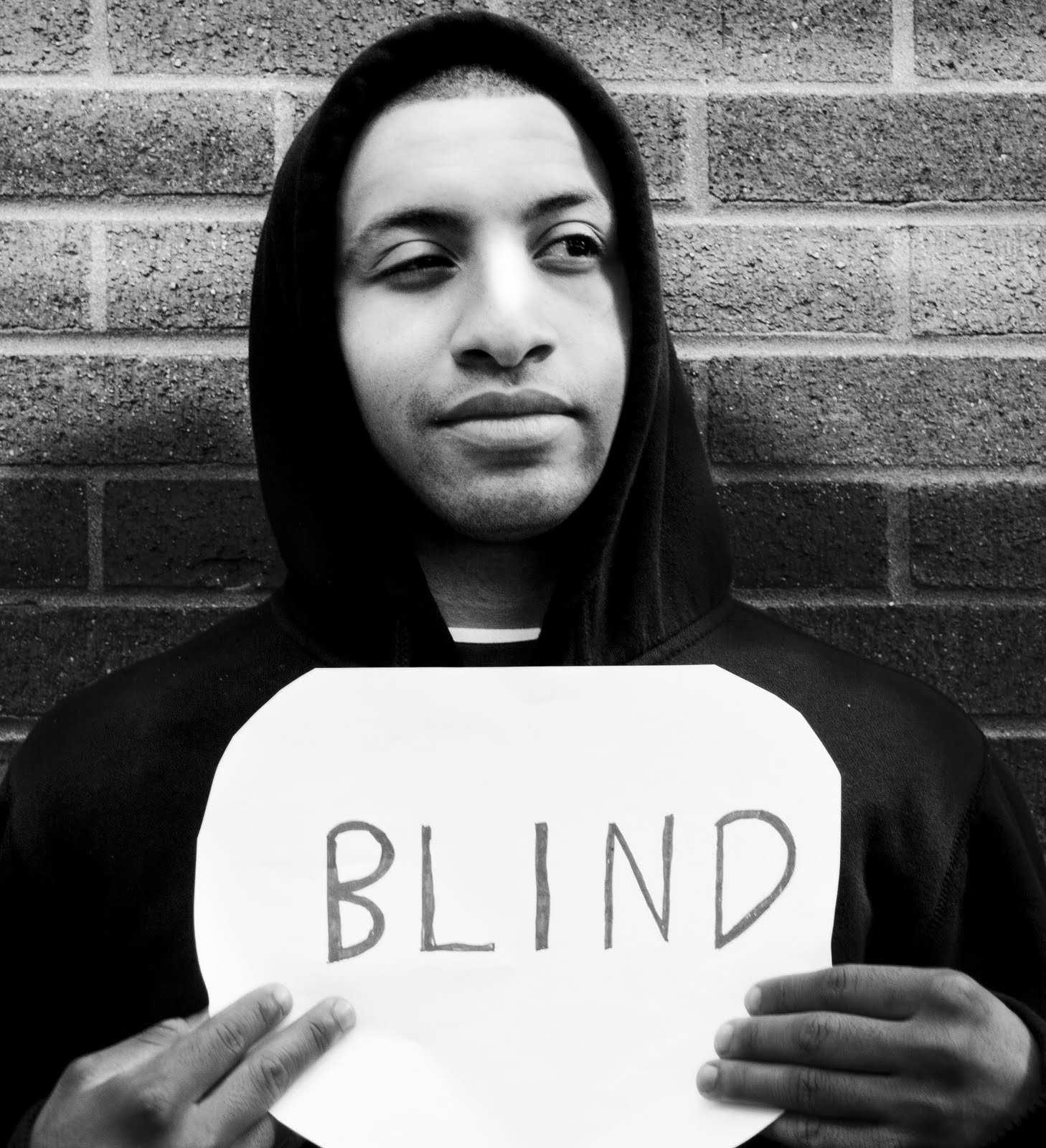
Recreation: Alison Manciu, Blind Man, 2011

Original: Paul Strand. Blind Woman, 1916
Paul Strand born in 1890 in New York city. He was a radical who confronted the world directly with his camera. Strand gave a take on meaning and made the viewers look at their surroundings. It was powerful and brutal at the same time. Strand took this photo when many others were taking portrait shots that conveyed beauty. During this period in his career he took many photographs of slums, drunks, and peddlers.
The photo, Blind Woman, is similar to a mug shot, the elderly blind woman stands stiffly against the stone wall. Her eyes are rolling in different directions, making it obvious that she is blind. The sign that reads, BLIND, dangles around her neck. She has a number above the sign that gives her the right to beg. The mood of this photo is of despair and of sadness. She is clearly in need. It is embarrassing to be labeled in such a way that you have a sign dangling around your neck. it objectifies her. He captured the world in this woman's face, as he did with many of his portrait photography.
The recreation I made is of a man holding the sign, BLIND. It also looks similar to a mug shot but he has a different expression and holds a different mood. he made and wrote the sign, showing his choice to be labeled. The eyes have a similar gaze, but he looks more mischievous, he could be cheating the system. he looks confident, like he is in control, where as the woman in Strand's photo looks helpless and hopeless. They are similar photos that give two different meanings.
Tuesday, May 24, 2011
Assignment 1: Explore
 |
| Untitled I |


 |
| Untitled II |
 |
| Untitled III |
Part I
Untitled I:
The composition was all chance. It was dark and raining so I had to make the shutter speed really slow. I just hoped as I was shooting that a clear enough photo would come along. The emphasis is on my dog, Payton, moving.
Concept is play. I wanted to capture the movement of Payton and how wound up he can get when he gets outside. I like to think of the blurred/ streaky background as what he sees when he is jumping and running around when he is outside.
I had my mom as an assistant with this photoshoot. She was throwing a tennis ball around for him to run after. I learned a lot about shutter speed in taking these photos. It was taking these photos that convinced me that I needed a tripod.
My goal for this image was to capture Payton's crazy hyper world when he plays outside. It was also to get to know shutter speeds better.
The context can be similar to other artists who focus on movement. It is interesting to compare slow shutter speed movement with fast shutter speed movement to see how they differ in interpretation.
Untitled II:
The composition frames the foot. The lighting comes from the back so there is great contrast that emphasizes the scar on the top of her foot that subtly shows.
The image is about expression that can be shown through body parts other than the face. It shows relief, as if she just put her feet up after a day that was strenuous on her wounded foot. The photo is also about learning to play with light and the angles that can give different moods.
I directed my subject and fixed the lighting as the method for this photo. I told the girl to put her foot up as I switched the light angles around the foor. I liked playing with vast contrast.
My goal for this image was to learn techniques with the camera more than a narrative or concept.
A photographer who exploits wounds and scarring and the idea of permanent, i may be able to compare my photo to. Also photographers who use vast contrast and background lighting.
Untitled III:
I used the lighting from the window for this composition. I framed the forks into focus with a straight on shot to show a different perspective on the floor.
The image is about chaos. It is not extreme chaos, but for a person with ocd, or for someone who is obsessed with cleanliness and germs, it would be chaotic to have your eating utensils fallen to the floor. I like the disarray and angles the forks make, as well as the texture of the carpet. the depth of field works as well.
My method was a lot of experimenting and constructing the scene. I started taking photos with the forks in a cup on the table, then knocked them over and continued to photograph them on the floor.
My goal was to experiment with the camera settings with an interesting and unusual subject.
The context of the image doesn't go very deep. You could relate this photo to the work of a photogrpaher who captures everyday objects, or who captures objects where they don't belong.
Part II
Untitled I:
Others interpreted this photo as the dog being quite still, with everything spinning around him. They also agreed that he was playing and excited.
What is working is the movement of the background. Suggestions were that it would have been nice to get more expression from Payton, maybe get him at a run rather than at a light trot.
As a jumping point I would continue to photograph Payton, maybe in better lighting and with a tripod. It would be neat to follow him around for a couple hours to see what he does when we are not watching. That would probably involve hidden sensor cameras around our yard.
Untitled II:
Others interpreted this image as someone putting up their feet to relax after a long day of work, with the expression, Ahhhh! Finally. they also commented on the permanent scar on her foot in relation to the indented patterned line her sock made around her ankle. It is interesting that one mark will fade away, but the other is there for life.
What is working is the expression the foot gives and the lighting. No negative feedback was given, but maybe I could have tried a variety of angles to see if another viewpoint was stronger.
I like the idea of photographing marks on your body that are not permanent, like the sock indent. It also may be interesting to take pictures of scars or tattoos, then come back years later to see how the scars have healed and how the person has changed physically.
Untitled III:
Others interpreted the image as forks that had fallen to the floor. Another interpretation I liked was that it resembled a landscape with the forks in the foreground and the depth of field and camera angle.
The contrast, texture, and composition are working. It was suggested that I completely darken the background but I like the hints of the fork's surroundings.
I really like the idea of this image resembling a landscape. That hadn't occured to me before. It would be fun to experiment with other household objects to see if I can construct the same idea.
Sunday, May 22, 2011
Blog Prompts Week 1 #1-4
#1
Imagine a world without photographs. Describe what this world would look like.
I don't know if I can imagine a world without photography. Pictures fill the walls and books I'm surrounded by. If we didn't have photography, we probably would not have television or other advancements influenced by photography. Popular culture and recent history would not hold the same intensity and reality. I don't think people would understand the world around them quite the way they do with the help of a photograph. Photographs hold memory and information that words can not describe. A form of communication we have gained through photography would be lost. Sharing between cultures, places, and time periods would be more difficult to appreciate and be aware of. It would be a new world people would have to adjust to. We would have to rely on paintings that take more time to develop and are through the perception of the painter. It is possible the transfer of information would slow down and hold different meaning when people do not have a photograph to help them imagine what is being described.
This quote is stating that we take photographs capture what is happening in the world. Photographs are known to portray a reality because it freezes a moment that happened. "But nothing is what appears to be," is stating that even though the appearance of the photo may seem real, it could be staged. There is an illusion to many photographs. Because it freezes merely a moment, how does the viewer know this moment is real? Even if it is not staged by the photographer, could the subject be staging him or herself as something they are not?
A modern example I am sure many are aware of is facebook. You can look at multiple albums of smiling faces that give the impression a person is living a fun filled life, to find that in reality the person sharing these albums has numerous troubles and isn't the happy person they portray. The images are chosen to be shared with hundreds of people and are usually not a true depiction of reality. Photographs can not always be a reliable source for the truth.
I think this quote can hold true in some circumstances but is not always the case for every photograph. The tricky part is telling the difference between the real happenings in photographs and the posers.
Hine is stating that some things can not be described well enough through words and verbal description; that images are needed to communicate some stories that can not be as accurately depicted through speech or written document. Words can not describe some feelings or events, you have to see it for yourself. I think this quote holds true to many photographs. It can describe and make you feel an emotion visually that words could not.
Picture documentations of war and suffering are stories better told through images because there is some suffering that I do not understand and have not dealt with first hand. Words do not suffice explaining certain tragedies because it is unimaginable until I see the reality. Photographs uncover certain emotions that words can not.
Words better describe a story when it is a simple message that is being passed. When it is the facts that do not trigger emotions. Words are needed for certain descriptions and definitions.
Imagine a world without photographs. Describe what this world would look like.
I don't know if I can imagine a world without photography. Pictures fill the walls and books I'm surrounded by. If we didn't have photography, we probably would not have television or other advancements influenced by photography. Popular culture and recent history would not hold the same intensity and reality. I don't think people would understand the world around them quite the way they do with the help of a photograph. Photographs hold memory and information that words can not describe. A form of communication we have gained through photography would be lost. Sharing between cultures, places, and time periods would be more difficult to appreciate and be aware of. It would be a new world people would have to adjust to. We would have to rely on paintings that take more time to develop and are through the perception of the painter. It is possible the transfer of information would slow down and hold different meaning when people do not have a photograph to help them imagine what is being described.
#2
What does the word "photograph" mean to you?
The word photograph initially makes me think of a reality or moment captured. The word memory also comes to mind. I always thought a photograph meant that a true event or emotion could be solidified and shared forever. After viewing photographs and learning about artists, my idea of a photograph has changed a bit. I still hold valid the truth that a photograph can capture, but I now see the photographer in the way photos are captured.
If you told someone to take a picture of a cozy house, what house would they photograph? Would they even photograph what you perceive as a house? The photographer's mark is left in a photograph and I didn't see that before. I used to think that the artist's apparent mark was what distinguished a painting from a photo. I think that seeing reality captured in new ways, as well as an appreciation brought forth to things most pass by, is what a photograph is to me.
The word photograph initially makes me think of a reality or moment captured. The word memory also comes to mind. I always thought a photograph meant that a true event or emotion could be solidified and shared forever. After viewing photographs and learning about artists, my idea of a photograph has changed a bit. I still hold valid the truth that a photograph can capture, but I now see the photographer in the way photos are captured.
If you told someone to take a picture of a cozy house, what house would they photograph? Would they even photograph what you perceive as a house? The photographer's mark is left in a photograph and I didn't see that before. I used to think that the artist's apparent mark was what distinguished a painting from a photo. I think that seeing reality captured in new ways, as well as an appreciation brought forth to things most pass by, is what a photograph is to me.
#3
“Photography deals exquisitely with appearances, but nothing is what it appears to be.”~Duane Michals. Write a brief reaction to this quote. Is this quote applicable to your experience with photography? What does it mean to you? Do you agree with the idea presented or disagree?This quote is stating that we take photographs capture what is happening in the world. Photographs are known to portray a reality because it freezes a moment that happened. "But nothing is what appears to be," is stating that even though the appearance of the photo may seem real, it could be staged. There is an illusion to many photographs. Because it freezes merely a moment, how does the viewer know this moment is real? Even if it is not staged by the photographer, could the subject be staging him or herself as something they are not?
A modern example I am sure many are aware of is facebook. You can look at multiple albums of smiling faces that give the impression a person is living a fun filled life, to find that in reality the person sharing these albums has numerous troubles and isn't the happy person they portray. The images are chosen to be shared with hundreds of people and are usually not a true depiction of reality. Photographs can not always be a reliable source for the truth.
I think this quote can hold true in some circumstances but is not always the case for every photograph. The tricky part is telling the difference between the real happenings in photographs and the posers.
#4
“If I could tell the story in words, I wouldn't need to lug around a camera.” ~Lewis Hine.
Write a brief reaction to this quote. Is this quote applicable to your experience with photography? What does it mean to you? Do you agree with the idea presented or disagree? Describe situations when photographic images reveal “the story” (as compared to words). Describe situations when words reveal “the story” (as compared to images).Hine is stating that some things can not be described well enough through words and verbal description; that images are needed to communicate some stories that can not be as accurately depicted through speech or written document. Words can not describe some feelings or events, you have to see it for yourself. I think this quote holds true to many photographs. It can describe and make you feel an emotion visually that words could not.
Picture documentations of war and suffering are stories better told through images because there is some suffering that I do not understand and have not dealt with first hand. Words do not suffice explaining certain tragedies because it is unimaginable until I see the reality. Photographs uncover certain emotions that words can not.
Words better describe a story when it is a simple message that is being passed. When it is the facts that do not trigger emotions. Words are needed for certain descriptions and definitions.
Tuesday, May 17, 2011
Recreation 01


Hugo Erfurth, Portrait of a Boy, 1906
Erfurth was a German photographer, alive between 1874 and 1948. He is known for portraits of celebrities and cultural figures of the early twentieth century. Much of his work was lost during the WWII years. The existing work has a photorealistic look, as of it was painted with soft charcoal. The lines are pretty blurred with soft blacks. I like how close the figure is in the foreground and how far away the landscape seems. The cropping of the subject is effective, a lot of what is surrounding him remains a mystery. The photo allows speculation about what he is looking at and whether or not the photo is staged. I also question his dress and why he is in the middle of the country. The linear lines and texture in the photo are effective. I like that the horizon is at the same height as the boys shoulders. The space the sky holds is very effective. The clouds have beautiful soft texture. I could not find anything online about the photo itself.
Monday, May 16, 2011
Wednesday, March 2, 2011


Thursday, February 24, 2011


Thursday, January 13, 2011
Recreation


Eugene Durieu
"Draped Female Nude"
This photograph is a series of many that Eugene Durieu completed while working with painter, Eugene Delacroix. The studies are considered very influential for early nude photography. The model is thought to be professional, and her turning away from the camera is part of a carefully thought out scene. Durieu had little contribution in the photograph's composition. He was the operator who handeled the camera, while Delacroix handled the scene. The photograph has a modern tone with its successful lighting and simple concept. Few of Dureiu's prints outside of the nude series have been found and documented.
Subscribe to:
Posts (Atom)